I made a presentation today about eportfolio and assessment for York College’s annual day of assessment conference. The problem was I showed up with a conversation about eportfolio and a bunch of animated GIFs (see below) and everyone else showed up with graphs, charts, and numbers.
When my colleague asked me to talk to faculty about eportfolio/assessment I was a bit torn. First, I haven’t been working on eportfolios at York for some time as the piloted platform, built on WP/BP has been under-supported rendering the space unusable (resurrection notice Boone to the rescue). And second I’ve grown a little ambivalent about one of the principal driving forces behind campuses considering adopting eporfolios, which is ASSESSMENT.
With trepidation, I decided that it might be interesting to foster a conversation with my faculty about eportfolio by looking at a rich conversation started by Martha Burtis on her blog. She described her role supporting UMW’s effort to choose an eportfolio platform on her campus. Martha decided to ask her community of peers for feedback. What resulted was a great thread of comments, and I thought they would be good foder for my presentation.
I pulled a number of interesting quotes and used a number of GIFs to support the talk. Here’s a basic summary of what I presented:
At the start I quoted Martha’s mission to find/create an eportfolio platform which would support the following,
- An interest in a system for tracking institutional assessment learning outcomes (on program-, departmental-, and the University-level) and reporting on these otucomes.
- A space for meta-cognitive reflection by students on their learning, perhaps as part of a larger look at how we advise students.
- A desire to provide students with a “leg-up” by giving them a robust platform for showcasing their intellectual and professional work and development.
- A need (specifically in the College of Education) to track student outcomes BEYOND graduation. New laws are requiring us to demonstrate the effectiveness of our students as teachers after they’ve graduated (for a indeterminate amount of time)
The eportfolio elephant in the room is/was the assessment piece. Literally there’s an administrative mandate that loomed over the decision making process.

Boone Georges followed up, and made a great point about how this top down mandate is problematic.
Systems can only succeed in their “institutional” goals (like assessment and alumni connections) if they succeed in their “curricular” goals (genuine student engagement with the platform).

Then Todd Conaway did a little edu-kungfu by substituting the word “students” with “teachers” in the eportfolio goals statement above. Which was a provocation that Martha summarized well as a need to get faculty to “walk the walk” when it comes to reflection and sharing.
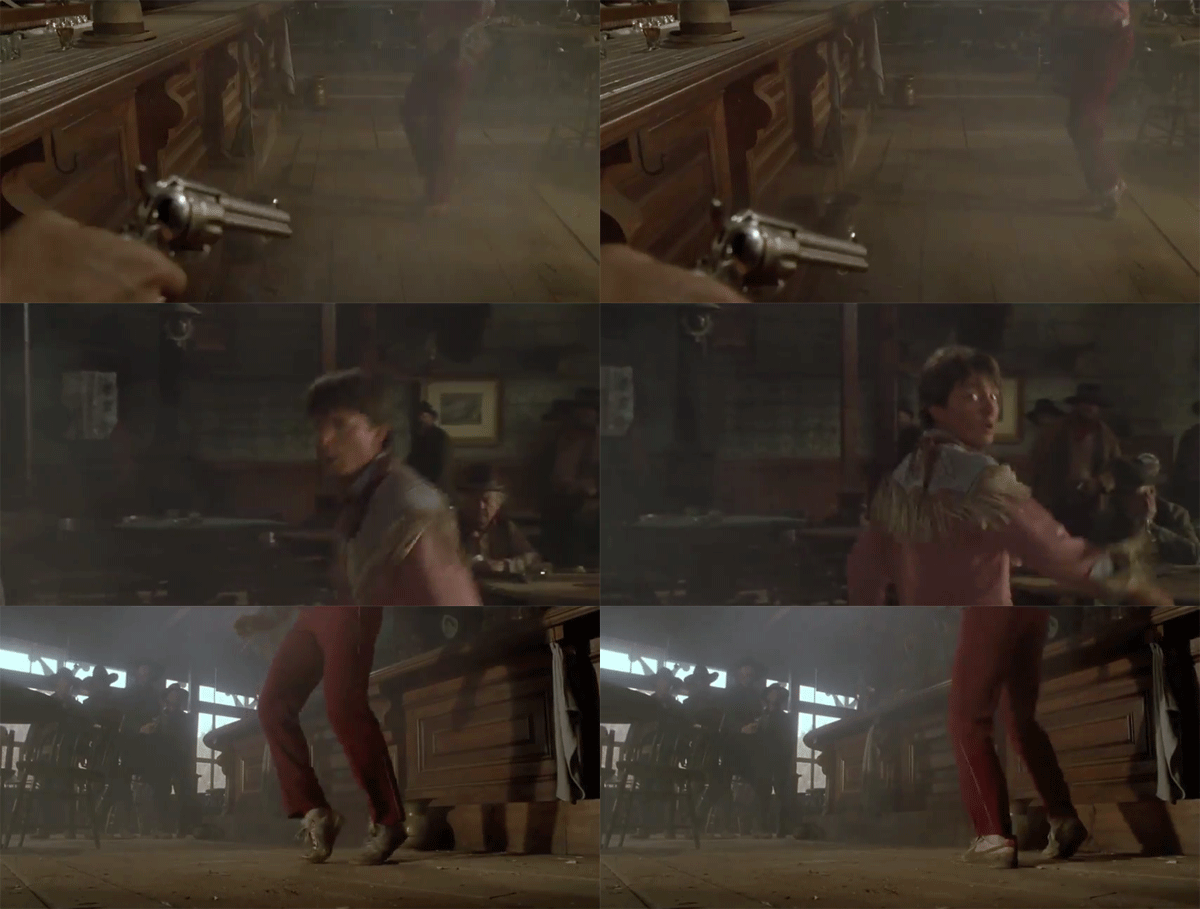
Joe Ugoretz introduced his struggles with using eportfolios for assessment, believing that universalizing a set of criteria to measure the success of each student is problematic, if it misses the value of uniqueness.
I’m suggesting I think an assessment that includes individuality, that celebrates it, and that allows us to understand what students themselves value about their accomplishments and their progress.

Antonio Vantaggiato did a great job of reminding everyone that the assessment process for instructors is quite natural, but there’s a new mandate.
When you *change* your methods, styles, technologies as a result of reflecting on how your students do, you are assessing, but now we are being asked to **document it**… the risk is that the reflective part begins with exploring the “how” to do it (document, track, etc.) , instead of focusing on the process.

And finally Gardner Campbell wrote about the limitations in the vernacular of ‘portfolios.’
I’ve been thinking that part of the problem is the metaphor of “portfolio,” which…is all about an inert and meaningless container…The metaphor gets an “e-” in front of it and begins to do damage to our ability to imagine the nature and potential of the new medium.

So I shared these GIFs and these many interesting points about eportfolio and platforms with my assessment crowd. And I got a flatline.
BEEEEEEEEEEEEEEEEEEEEEEEEEEEEEEEEEEEEEEEEEEEEEEEEEEEEP.
I think I basically sucked it sadly. I was hoping that I might encourage my colleagues to rethink the eportfolio, as an assessment tool born out of Martha’s eportfolio goals 2 & 3 focused on student reflection and presentation. Talk about it a bit. But I sucked it. Dead room.
I’m disappointed in myself as I imagined I might be effective at fostering a conversation as cool as Martha’s in her blog. But I’ve a long way to go.
Comments
5 responses to “GIFing a Great Conversation About EPortfolio”
Earlier today I told @cogdog that he needed a fancy hat and sporty shoes to do good presentations for teachers and stuff. I know those things help. I have seen you present content to teachers and I know you are well behaved, dressed in decent attire, and most notably, just enough beard to make you look thoughtful. Those things combined with the fancy hat and sporty shoes should make you a frickin star no matter what you talk about.
Now I am sure everyone at the assessment conference was really, I mean really, really really excited to be there. I know I would be. Nothing like talking to excited people to get things going.
Did I mention the thing about fancy shoes? That always works in sharing thoughtful ideas with faculty.
I don’t know what kind of shoes you have on, but you clearly pondered the challenges of assessment and the eportfolio here and back on Martha post. You are walking the talk (in really fancy shoes no doubt) and that is good. You can lead faculty to a better place but you can’t make them want to be there.
I think eportfolios take way too much time to grade and think about. I prefer Scantrons. All the video and images, gifs if you are dealing with angels, and all the creative crap just gets in the way of easily grading the &(^% students do. And what is up with that “authentic” word anyway. Is is so yesterday and stuff. And, “thinking about what you do?” WTF! Give me oodles of T/F questions and someone to grade them for me and I am soooo happy.
And the students? *&# ’em. They usually wear crappy looking shoes and never any fancy hats.
Did I tell you about my advise about hats and shoes while doing presentations to faculty?
True or False: Karaoke means “empty orchestra” in Japanese.
Next time I’ll be ready to do a real presentation.
For all we talk about building environments that promote active/engaged learning, when you put a group of teachers in a room all they wanna do is complain or listen. A real empty orchestra.
After teaching high school for 10 years and teaching groups of teachers for 6 I have learned one thing. The two groups are exactly the same. The strategies that work with high school students work with teachers. The ones that don’t, don’t.
I always feel like I am inches away from bullet pointing them to death and at the edge of chaos. “So, does anyone have an example of why this is such a challenge?”
Silence.
“No?”
“Well, does anyone know why no one in this room willing to participate in this conversation?”
Just like what a portfolio can do, keeping the conversation engaged in the conversation itself can help the clarify the context, is reflection and learning about how and why we learn, and that interaction part, where digital portfolios can shine, makes the experience something different than watching a speaker or a television set.
Maybe next time just talking about rubrics or PARCC or some other trendy topic will suffice. Then you can expect a flat-line response and they will get what they wanted.
FWIW, it’s not like I get a lot of uptake on my end from talking about this at UMW. In fact, this project ended with us basically saying, “Look, you can either do real curricular change and bake ePortfolios into it, or you can just put something out there for students to use to build what they want and see what comes of it.” No one bit on the former. In some ways, Domain of One’s Own is a piece of an approach to the latter — and I believe that the students who engage with it will create something of real value. But it won’t be wholly tied to their academic experience, so it won’t be fully reflective of the development of their lives and minds at the University.
I feel like we’re at this weird crossroads. For years, we’ve worked with faculty on course-based projects that have resulted in real innovation and transformation. Occasionally, these have extended beyond a single course into a cohort of courses. But now we’re at the point where to go to the next level (with ePortfolios, online learning, etc.) we have to have some kind of serious institutional commitment to curricular change. Instructional technologists can’t make this happen. A single faculty member can’t make this happen. A few faculty members can’t make this happen. A president or provost (acting alone) MIGHT be able to make this happen, but no one will be happy about it. To do this well and right, we need a cultural shift and a communal recognition that change needs to happen. I’m not so sure this is possible, and I quite sure it can only happen with a large cohort of engaged, enlightened, and enthusiastic faculty, administrators, and staff. I hope I live to see it.
Thanks Martha for jumping in.
Over the past couple years, it’s been amazing to learn about all of the successes of UMW blogs, participate in DS106, and marvel at the Domain of One’s Own project, all which come out of your awesome shop DTLT. If there’s a school that I would hope has a good shot at institution wide transformation it would be UMW, even if it’s at a crossroads for now.
What will it take to get to that other side? Is it some sort of seismic disruption that drags everyone suddenly in? I worry that examples like UVa’s knee jerk firing of a president or worse the entire California State University system outsourcing online education to Pearson are the beginnings of an ugly trend. People in leadership positions are throwing their hands up and saying we can’t do this, rather than investing in their own people to learn and build solutions of their own. And never mind not recognizing that this building should be done with an eye toward sharing and collaboration with the larger community – particularly at public institutions which are funded by the community.
The work you’re doing with UMW hasn’t transformed the entire institution – yet. But I think it’s one of the most likely schools to actually pull it off in the coming years. And I’m rooting like crazy for you all.